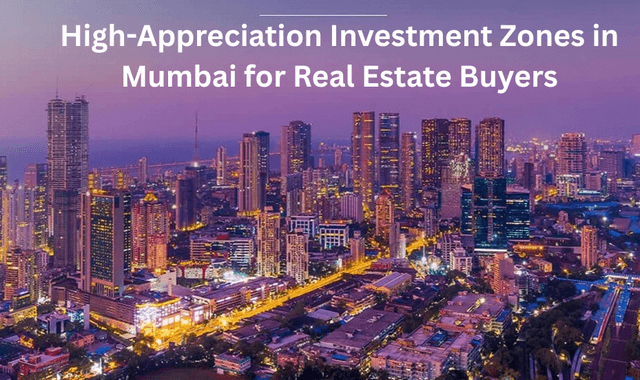
Mumbai’s real estate market continues to attract homebuyers and investors looking for locations that can offer both long-term value and strong connectivity. While established areas such as South Mumbai, Bandra and Worli remain important premium markets, a large part of the city’s future property growth is now being shaped by infrastructure development, expanding employment hubs and new residential corridors.
In 2026, the Mumbai Metropolitan Region (MMR) is seeing increased attention toward areas such as Navi Mumbai, Panvel, Thane, Mulund, Bhandup, Powai, Goregaon, Malad, Borivali and Mira-Bhayandar. Recent market reports indicate that several of these locations have recorded price growth as new roads, metro lines, airports and other transport projects improve accessibility.
For property buyers, the key is not simply to identify a locality where prices are rising today. It is also important to understand why demand is increasing, what infrastructure is coming up, how established the neighbourhood is and whether future development is likely to support resale demand.
Navi Mumbai: A Major Infrastructure-Led Growth Zone
Navi Mumbai has emerged as one of the most closely watched real estate markets in the MMR. The area has benefited from several major infrastructure developments, including the Mumbai Trans Harbour Link (Atal Setu), metro expansion and the Navi Mumbai International Airport.
The airport factor has added another layer to Navi Mumbai's real estate story. Atal Setu has also improved road connectivity between Mumbai and Navi Mumbai, making locations that were once considered relatively distant more accessible.
Market data from Magicbricks showed that Navi Mumbai recorded a 2% quarter-on-quarter increase in residential demand in Q4 2025, while its rate index increased 4.7% during the same period.
For buyers looking at established locations, Kharghar remains an important residential market. For those willing to consider longer-term development, Panvel and surrounding areas are also receiving attention because of the airport and wider infrastructure network.
The Economic Times reported that Navi Mumbai accounted for 34.5% of residential sales in MMR in Q1 2026, while also accounting for 30.3% of new launches.
This makes Navi Mumbai particularly relevant for buyers looking beyond the traditional Mumbai city limits.
Panvel: Airport and Connectivity Can Support Long-Term Demand
Panvel has moved from being primarily a peripheral residential market to an increasingly important part of the MMR development story.
The Navi Mumbai International Airport and Atal Setu are two major factors supporting interest in the area. The wider network of highways and regional infrastructure is also helping Panvel become more connected to Mumbai and other parts of Maharashtra.
Current market reports place typical asking prices for ongoing projects in the Navi Mumbai-Panvel corridor broadly around ₹15,000–₹20,000 per sq ft, although actual prices vary considerably depending on the project, location, construction stage and specifications.
For investors, Panvel also offers something that many established Mumbai locations cannot: relatively larger homes and new developments at prices that can be lower than central Mumbai.
However, buyers should distinguish between different parts of Panvel. A property close to major roads, transport links, established neighbourhoods and planned commercial development may have a very different resale profile from a project located farther away from existing facilities.
Thane West: Established Demand with New Infrastructure
Thane has increasingly become an alternative to Mumbai for buyers who want larger homes without moving too far away from the city's employment centres.
Thane West, particularly areas around Ghodbunder Road, Pokhran Road, Majiwada and Kolshet, has attracted substantial residential development. The area's appeal comes from a combination of housing choices, schools, hospitals, shopping centres and road connectivity.
Thane also stands to benefit from continued expansion of the wider metro network. The region is increasingly being integrated with Mumbai and other parts of the MMR through road and public transport projects.
Historical price data also shows the scale of long-term appreciation in Thane West. Mumbai Property Exchange's 2026 index places the median quoted rate at around ₹19,885 per sq ft, compared with ₹2,100 per sq ft in 2005.
Past appreciation, however, should not be treated as a guarantee of future returns. For new buyers, the more important question is whether the individual property's location, construction quality, connectivity and surrounding development justify its current price.
Mulund and Bhandup: Strong Links Between Mumbai and Thane
Mulund and Bhandup occupy an interesting position between Mumbai and Thane. They benefit from access to the Eastern Express Highway, railway connectivity and proximity to established residential and commercial areas.
The proposed and ongoing improvement of east-west connectivity is another factor attracting attention. The Goregaon-Mulund Link Road, for example, is expected to improve movement between Mumbai's eastern and western suburbs once completed.
These areas may appeal to buyers who want to remain within Mumbai while looking for comparatively more affordable options than some of the western suburbs.
The redevelopment of older properties is also changing the housing stock in several parts of the eastern suburbs. New residential projects can offer modern amenities while remaining connected to established neighbourhood infrastructure.
Powai: An Established Premium Market with Strong Employment Links
Powai is not an emerging location in the traditional sense, but it continues to be relevant for buyers looking for a combination of residential demand, employment access and established social infrastructure.
The locality benefits from its proximity to business areas, educational institutions and the airport corridor. Its connection to the Jogeshwari-Vikhroli Link Road also provides access toward the western and eastern suburbs.
Long-term price data shows substantial appreciation in Powai. According to Mumbai Property Exchange, its median quoted residential rate increased from ₹3,111 per sq ft in 2005 to around ₹29,591 per sq ft in 2026.
The challenge for new investors is the relatively high entry price. Buyers therefore need to pay close attention to the age of the building, redevelopment potential, maintenance costs and exact location rather than assuming that the entire Powai market will perform in the same way.
Goregaon and Malad: Western Suburbs Getting Better Connected
Goregaon and Malad remain among Mumbai's important residential markets, supported by employment centres, shopping facilities, schools and access to major roads and public transport.
Metro Lines 2A and 7 have improved connectivity across the western suburbs, while further infrastructure development is expected to strengthen links between different parts of Mumbai.
The Goregaon-Mulund Link Road is another project being watched closely because it could improve east-west travel and make the western suburbs more accessible to residents working in Mumbai's eastern business districts.
These areas can therefore appeal to both end-users and investors. Rental demand can also be supported by nearby employment centres, although investors should examine rental yields and tenant demand at the individual building and locality level.
Borivali and Kandivali: Northern Suburbs with Expanding Connectivity
Borivali and Kandivali have traditionally attracted families looking for relatively spacious homes and access to established civic facilities.
Their connectivity story has improved with Metro Lines 2A and 7, which have added another public transport option along the western corridor.
Borivali also benefits from railway connectivity and access to the Western Express Highway. As infrastructure improves in the northern suburbs, locations with easy access to stations, metro stops and major roads may receive greater buyer attention.
For investors, one advantage of these markets is that they already have established residential communities. This can reduce some of the uncertainty associated with investing in completely new development corridors.
Mira-Bhayandar: A Growing Alternative to the Western Suburbs
Mira-Bhayandar has increasingly attracted buyers searching for homes at prices that can be more accessible than established western Mumbai locations.
The extension and development of metro connectivity has strengthened the area's connection with Mumbai. Metro Line 9, which serves the Dahisar-Mira Bhayandar corridor, is another important part of the region's changing transport network.
The area is also developing its own schools, retail facilities, healthcare services and residential communities. This gradual shift toward becoming a more self-contained urban area could support housing demand over time.
However, buyers should compare different neighbourhoods carefully. Travel time, road congestion, access to stations and the quality of local infrastructure can vary significantly within the wider Mira-Bhayandar market.
Worli and Mahalaxmi: Premium Locations with Infrastructure Support
For buyers with larger budgets, Worli and Mahalaxmi remain significant parts of Mumbai's premium residential market.
The Mumbai Coastal Road has strengthened connectivity along the southern and western portions of the city, while Metro Line 3 has improved access between South Mumbai, Worli and BKC.
Mumbai's prime residential segment also continues to show price growth. Knight Frank's Q2 2026 data, reported by Hindustan Times, showed Mumbai's prime residential prices rising 6.2% year-on-year.
These locations have a different investment profile from emerging areas such as Panvel or Kalyan-Dombivli. Entry prices are much higher, but buyers are purchasing in mature neighbourhoods with established infrastructure, employment access and premium housing demand.
Recent market commentary also shows that infrastructure is reshaping housing demand across Mumbai and the wider MMR, with areas including Chembur, Mulund, Bhandup, Thane, Kandivali, Malad and Borivali recording notable price increases over the past two years, according to experts cited by the Economic Times.
How Buyers Can Assess an Appreciation-Focused Property
Investors should avoid buying purely because a broker or developer describes an area as the "next big location." Instead, buyers can look at practical indicators.
First, compare current property prices with nearby established locations. Second, check how long it takes to reach major employment hubs during normal working hours. Third, examine the availability of schools, hospitals, supermarkets and public transport.
It is equally important to check the project's legal and construction details. For under-construction properties, buyers should verify the project's MahaRERA registration, construction progress, promised possession date, carpet area, parking terms, maintenance charges and the developer's previous delivery record.
Buyers should also remember that an infrastructure project can improve an area's prospects without guaranteeing a specific percentage of property appreciation. The impact can vary depending on the exact distance from a transport link, existing property prices, competing projects and the pace at which commercial and social infrastructure develops.
For many Mumbai real estate buyers in 2026, the most closely watched investment zones therefore stretch beyond the traditional city centre. Navi Mumbai and Panvel are being shaped by airport and regional connectivity, Thane and the eastern suburbs are benefiting from improving links with Mumbai, while the western suburbs continue to gain from metro-led connectivity. Mature premium markets such as Powai, Worli and Mahalaxmi remain important, but their higher entry prices make property selection particularly important.
India’s real estate market continues to transform alongside infrastructure expansion, urban development, and changing homebuyer expectations. As new residential corridors and growth micro-markets emerge, opportunities are expanding beyond traditional city centres. Buyers and investors who track infrastructure projects, connectivity improvements, and planned urban growth are better positioned to identify high-potential locations and maximise long-term property value. Whether the objective is buying a home for self-use or building a diversified real estate investment portfolio, success depends on choosing the right location, entering at the right time, and making well-informed decisions. Evaluating neighbourhood development trends, selecting legally compliant and transparent projects, and aligning property purchases with long-term financial and lifestyle goals can significantly improve overall returns and ownership satisfaction. As the sector continues to mature, real estate remains one of the most stable long-term investment options. With careful planning, market awareness, and strategic decision-making, property investments made today can support wealth creation, financial security, and sustainable lifestyle growth in the years ahead.
- Verified Tenants/Buyers
- Unlimited Property Listing
- Zero subscription/charges fee