Buying a home in Mumbai is a major financial decision, especially when property prices, registration charges, taxes and other expenses add up to a substantial amount. While most homebuyers focus on the advertised property price, the actual amount they need to pay can be considerably higher. This is where a property cost sheet becomes important.
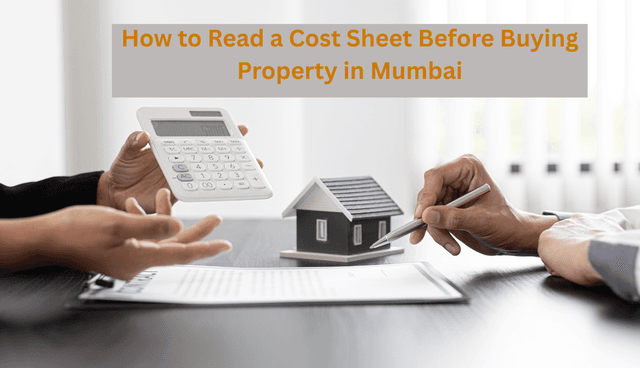
A cost sheet is a document provided by a builder or developer that explains the different charges associated with purchasing a property. It usually includes the basic apartment price, parking charges, government taxes, registration expenses, maintenance deposits and other payments. Understanding these details helps buyers calculate the total cost of ownership and avoid unexpected expenses during the home-buying process.
For first-time homebuyers, reading a cost sheet can sometimes feel confusing because it contains several line items, unfamiliar terms and payment conditions. However, understanding each component can make it easier to compare residential projects, negotiate with developers and plan a realistic budget.
Whether you are planning to purchase a compact apartment, a luxury home or an investment property, knowing how to read a cost sheet before buying property in Mumbai can help you make a more informed decision.
What Is a Property Cost Sheet?
A property cost sheet is a detailed breakdown of the expenses involved in purchasing a residential or commercial property. Developers generally provide this document to prospective buyers so they can understand the different charges applicable to a particular unit.
The cost sheet typically mentions the apartment's basic price, the applicable taxes, additional facilities, deposits and other charges payable before possession or registration.
For example, a builder may advertise an apartment in Mumbai for ₹1 crore. However, this amount may represent only the basic property price. After adding stamp duty, registration charges, applicable Goods and Services Tax (GST), parking fees and other expenses, the final amount payable could be significantly higher.
The exact amount depends on the property's location, carpet area, construction status, applicable taxes, facilities offered and the terms of the agreement.
It is important to remember that a cost sheet is not necessarily the final legal agreement between the buyer and the developer. Buyers should compare it with the registered project details, the builder-buyer agreement and other relevant documents before making payments.
1. Check the Basic Property Price First
The basic property price is usually the largest component of a cost sheet. It represents the price charged by the developer for the apartment before adding other applicable charges.
For instance, if a 2 BHK apartment in Mumbai has a basic price of ₹1.20 crore, the cost sheet should clearly explain how this amount has been calculated.
Buyers should check the following details:
Apartment configuration: Confirm whether the property is a 1 BHK, 2 BHK, 3 BHK or another configuration.
Carpet area: Check the actual usable floor area of the apartment, measured according to the applicable legal definition.
Price per square foot: Understand the rate used by the developer to calculate the basic price.
Floor preference: Check whether the price changes depending on the floor on which the apartment is located.
View or location premium: Find out whether the developer charges extra for a sea view, garden view, corner apartment or other preferred location.
Discounts: Verify whether any advertised discount has already been deducted from the quoted price.
Carpet area deserves particular attention because it represents the area within the apartment that buyers can use, subject to the statutory definition. A larger advertised area does not always mean more usable space.
For example, two apartments may have similar prices but different carpet areas. Comparing their prices per square foot of carpet area can help buyers determine which property offers better value.
However, the lowest price per square foot does not automatically make a property the better choice. Location, construction quality, amenities, connectivity and the developer's track record should also influence the decision.
2. Understand the Difference Between Carpet Area and Other Areas
Mumbai developers may use different area measurements while advertising residential projects. Understanding these measurements is essential when checking the cost sheet.
Carpet area refers to the usable floor area within the apartment, as defined under the applicable regulations. It generally excludes external walls, service shafts, exclusive balconies or verandahs, and exclusive open terraces, while including internal partition walls as prescribed under the legal definition.
Built-up area generally includes the carpet area along with the area occupied by walls and other permitted components.
Super built-up area, where used, may include a proportionate share of common areas such as lobbies and corridors. It should not be confused with the carpet area specified under the Real Estate (Regulation and Development) Act, 2016.
Before booking an apartment, check which area measurement forms the basis of the quoted price. Under RERA, apartment advertisements and disclosures are required to follow applicable carpet-area requirements.
Buyers should also verify the carpet area mentioned in the cost sheet against the details available on the Maharashtra Real Estate Regulatory Authority's official portal.
You can check registered project information through the official website of MahaRERA.
3. Examine Floor Rise and Other Premium Charges
Some residential projects in Mumbai have different prices for apartments on different floors. Developers may charge an additional amount for higher floors, preferred views or specific apartment locations.
These charges are often listed separately in the cost sheet.
For example, a developer may quote a basic price of ₹1.20 crore for an apartment and add a floor-rise premium of ₹2 lakh for a unit on a higher floor.
Similarly, a corner apartment or a unit overlooking landscaped gardens may carry an additional premium.
Before accepting these charges, ask the developer to clarify:
Whether the premium is compulsory.
How the amount has been calculated.
Whether the premium is included in the advertised price.
Whether the same charge applies to every apartment on that floor.
Whether any discount is available on the premium.
Buyers should compare the final prices of similar apartments rather than relying solely on the starting price advertised by the builder.
A project promoted as offering apartments
A project promoted as offering apartments at an attractive entry price may have several additional charges that increase the final cost.
4. Check Parking Charges Carefully
Parking is an important consideration for Mumbai homebuyers, particularly in areas where finding a convenient parking space can be difficult.
A cost sheet may mention parking-related charges separately. Buyers should examine these entries carefully and ask the developer to explain what the payment covers.
Do not assume that every parking-related amount listed by a developer is automatically payable. The legality of the charge depends on the nature of the parking space, the applicable rules and the terms of the transaction.
The Supreme Court has distinguished between the sale of a flat and the treatment of common parking areas under applicable housing laws. Buyers should therefore verify whether a proposed charge relates to a lawful, separately saleable facility or a common area.
Ask the developer to clarify the following:
Whether parking is included in the quoted apartment price.
What type of parking facility is being offered.
Whether the parking space is identified in the project documents.
Whether the charge is permitted under the applicable rules.
Whether parking availability and allocation are recorded in the agreement.
A clear explanation at the booking stage can help prevent disagreements later.
5. Understand GST on Under-Construction Properties
Goods and Services Tax is another important component to examine when reading a property cost sheet.
The GST treatment of residential property depends on factors such as the type of property, its construction status and whether the transaction falls within the applicable taxable category.
Under the current framework, qualifying under-construction residential apartments are generally subject to GST at prescribed rates. The commonly applicable rates are 5% for residential apartments outside the affordable housing category and 1% for qualifying affordable residential apartments, subject to the relevant conditions.
For qualifying residential projects covered by the concessional scheme, these rates generally apply without the benefit of input tax credit for the developer.
Completed properties sold after the relevant completion certificate or first occupation, as applicable under GST law, are generally outside the scope of GST on the sale itself.
Consider a simplified example in which an under-construction apartment has a taxable value of ₹1 crore. If the applicable GST rate is 5%, the GST amount would be ₹5 lakh.
This is only an illustration. The actual taxable value, applicable rate and treatment of individual charges must be verified for the specific transaction.
Buyers should ask the developer to identify the GST rate, taxable amount and charges to which GST applies. They should also check whether the quoted price already includes GST or whether it will be collected separately.
Never assume that GST applies uniformly to every amount shown in a cost sheet. Different charges may receive different tax treatment depending on the circumstances.
6. Calculate Stamp Duty and Registration Charges
Stamp duty and registration charges are major expenses when purchasing property in Mumbai. These payments are separate from the basic apartment price and should be included in the overall purchase budget.
Stamp duty is a government charge payable on property transactions. Registration charges are paid to register the relevant property documents with the government.
The amount payable can depend on the property's location, transaction value, applicable market valuation rules, the nature of the document and any eligible concessions.
In Mumbai, buyers should check the applicable stamp duty rate and registration fee with the Maharashtra government's registration and stamps department before finalising their budget.
The government's official portal, Department of Registration and Stamps, Maharashtra, provides information and services relating to property registration and stamp duty.
When reviewing the cost sheet, check whether stamp duty and registration charges are:
Included in the quoted total.
Listed as separate estimated expenses.
Payable directly to the government.
Calculated using the appropriate valuation and applicable rates.
Some developers provide an estimate of these expenses for convenience. Buyers should independently verify the amounts because government charges can vary according to the transaction and applicable rules.
It is also important to check whether any additional government levies apply to the specific property transaction.
7. Look for Maintenance Deposits and Society Charges
Many buyers concentrate on the purchase price and overlook the money required for maintenance and building management.
Residential projects may include several charges related to the upkeep of common facilities. These can include advance maintenance payments, deposits for the building's maintenance fund, common-area expenses and charges associated with establishing or managing the housing society.
The exact charges vary between projects.
A cost sheet may include:
Advance maintenance charges.
Maintenance deposits.
Common-area maintenance contributions.
Society formation charges, where applicable.
Deposits for shared facilities.
Other permitted building-management expenses.
Suppose a developer asks for an advance maintenance payment of ₹60,000 and a separate maintenance deposit of ₹40,000. The combined initial outlay would be ₹1 lakh.
Buyers should ask whether these amounts cover different purposes and how long the advance maintenance payment will last.
It is also important to understand when regular monthly maintenance payments will begin and who will manage the building before the housing society or other appropriate management body takes over.
Request a written explanation of each maintenance-related charge. If the developer collects a deposit, ask whether it is refundable, adjustable against future expenses or intended for a specific purpose.
These details can make a meaningful difference to the total cost of buying and maintaining a home in Mumbai.
8. Identify Charges for Amenities and Clubhouse Facilities
Modern residential projects often advertise facilities such as swimming pools, gyms, landscaped gardens, children's play areas, clubhouses and indoor sports facilities.
However, the cost sheet may show additional charges associated with these amenities.
Some developers include the cost of common facilities in the apartment price, while others list certain charges separately.
Before paying, buyers should clarify whether the quoted amount covers access to the advertised facilities or whether additional membership or usage fees will apply.
Questions worth asking include:
Is clubhouse access included in the purchase price?
Is there a separate membership fee?
Are any facility deposits refundable?
Will residents have to pay recurring charges for certain amenities?
Are the promised facilities included in the approved project plans?
When are the facilities expected to be ready for use?
Buyers should also distinguish between a one-time payment and a recurring expense.
A clubhouse membership fee may be payable once, whereas the maintenance of common amenities may be charged periodically.
Understanding this difference helps buyers estimate both their initial investment and their future household expenses.
9. Check Legal, Documentation and Utility Charges
A cost sheet may include payments for documentation, legal administration, utility connections and other services associated with the apartment.
Depending on the project and transaction, these entries may relate to electricity connections, water connections, infrastructure, documentation or administrative services.
However, the presence of a charge on a cost sheet does not automatically mean it is legally payable.
Buyers should request a clear explanation of the purpose of each amount and check whether the charge is supported by the agreement and applicable rules.
Pay particular attention to entries described using broad terms such as miscellaneous charges, infrastructure fees, administrative expenses or documentation costs.
Ask the developer to provide a written breakdown instead of accepting a single combined amount without clarification.
For example, if a cost sheet mentions ₹75,000 under miscellaneous charges, the buyer should ask for the individual items that make up this figure.
This makes it easier to determine whether the expenses are reasonable, duplicated elsewhere in the cost sheet or already included in the basic price.
Where necessary, an independent property lawyer can review the proposed charges and the relevant clauses in the agreement.
10. Review the Payment Schedule Before Booking
A property cost sheet usually provides information about when different payments must be made.
The payment schedule may include an initial booking amount, payments linked to construction progress, instalments due at specific stages and a final payment before possession.
For under-construction properties, buyers should check whether the payment demands are linked to the construction stages and are consistent with the registered agreement and applicable legal requirements.
For example, the developer may ask for an initial booking amount followed by instalments as construction progresses. The final amount may become payable when the apartment is ready for possession, subject to the agreed terms.
Before signing, verify:
The booking amount and its refund conditions.
The dates or construction stages linked to instalments.
The amount payable at each stage.
The deadline for making each payment.
The consequences of delayed payments.
The conditions for cancellation.
Any additional charges payable before possession.
Buyers should not rely only on verbal assurances from sales representatives. Payment terms and important promises should be recorded in the relevant written documents.
It is equally important to ensure that the payment schedule is manageable within the buyer's income, savings and home loan arrangements.
An attractive property price can become difficult to manage if large instalments are due within a short period.
11. Compare the Cost Sheet With the Agreement for Sale
One of the most important steps before booking a property in Mumbai is checking whether the cost sheet matches the agreement for sale.
The cost sheet summarises the financial details, while the agreement sets out the legally binding terms of the transaction.
Buyers should compare the basic price, carpet area, payment schedule, additional charges and possession-related terms across both documents.
They should also check whether any advertised discounts or special offers are recorded in writing.
If the sales representative promises free parking, waived maintenance charges or a discount on the apartment price, ask for the applicable terms to be documented.
Do not assume that a verbal promise will automatically become part of the final agreement.
Buyers should also verify the project's registration details, approved plans and other relevant disclosures through MahaRERA.
Any difference between the cost sheet and the agreement should be clarified before signing or making a substantial payment.
12. Calculate the Total Cost of Buying the Property
The most useful figure on a cost sheet is not necessarily the basic apartment price. It is the total amount the buyer must pay to complete the purchase and take possession, along with any relevant initial expenses.
To estimate this amount, add the basic property price, applicable premiums, legally payable additional charges, taxes, stamp duty, registration fees and other transaction expenses.
14. Watch for Red Flags in a Property Cost Sheet
A cost sheet should provide a clear explanation of the expenses associated with a property. If the document contains vague entries, unexplained amounts or conflicting information, buyers should seek clarification before proceeding.
Some warning signs include:
- Unexplained miscellaneous charges: Large amounts without an itemised breakdown should be questioned.
- Different prices in different documents: The advertised price, cost sheet and agreement should be checked for inconsistencies.
- Unclear carpet area: The apartment's area should be verified against the applicable legal definition and project disclosures.
- Unspecified taxes: The developer should explain the applicable tax treatment and the basis of the calculation.
- Unclear parking charges: Buyers should verify the nature and legality of the proposed payment.
- Unwritten discounts: Special offers should be documented rather than accepted only through verbal assurances.
- Unclear refund terms: Booking cancellation conditions and deductions should be understood before paying.
- Unexpected possession charges: Buyers should ask for a breakdown of any additional amounts payable before possession.
A developer should be able to explain the different entries in the cost sheet and provide supporting information where required.
If an explanation is incomplete or inconsistent with the agreement, buyers should consider seeking independent legal advice before signing.
India’s real estate market continues to transform alongside infrastructure expansion, urban development, and changing homebuyer expectations. As new residential corridors and growth micro-markets emerge, opportunities are expanding beyond traditional city centres. Buyers and investors who track infrastructure projects, connectivity improvements, and planned urban growth are better positioned to identify high-potential locations and maximise long-term property value. Whether the objective is buying a home for self-use or building a diversified real estate investment portfolio, success depends on choosing the right location, entering at the right time, and making well-informed decisions. Evaluating neighbourhood development trends, selecting legally compliant and transparent projects, and aligning property purchases with long-term financial and lifestyle goals can significantly improve overall returns and ownership satisfaction. As the sector continues to mature, real estate remains one of the most stable long-term investment options. With careful planning, market awareness, and strategic decision-making, property investments made today can support wealth creation, financial security, and sustainable lifestyle growth in the years ahead.
- Verified Tenants/Buyers
- Unlimited Property Listing
- Zero subscription/charges fee