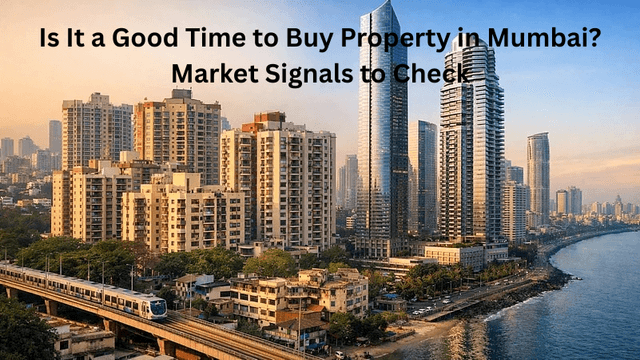
Mumbai has always been one of India’s most closely watched real estate markets. Property prices are high, demand is strong and good homes in established locations can attract buyers quickly. This often leaves homebuyers with one difficult question: Is it a good time to buy property in Mumbai, or should you wait for prices to come down?
The answer is not the same for every buyer. Someone purchasing a home for personal use may have different priorities from an investor looking for rental income or long-term appreciation. Instead of trying to predict whether Mumbai property prices will suddenly fall, buyers can look at a few practical market signals.
The latest numbers suggest that Mumbai's real estate market remains active in 2026. At the same time, buyers are becoming more careful about location, pricing, property size and the reputation of the developer. Anarock's latest survey also found that buyers continue to show interest in real estate despite higher prices, with greater attention being given to larger homes, premium properties and established developers.
Here are the major Mumbai property market trends and signals buyers should check before making a decision.
Mumbai Property Market in 2026: What Is Happening?
Mumbai's housing market has remained relatively steady despite high property prices.
During the first half of 2026, Mumbai recorded 47,355 residential sales, according to Knight Frank India data. This was about 1% higher than the corresponding period in 2025. Developers also launched 49,161 new homes during the period, an 8% increase from the previous year. At the same time, unsold housing inventory fell 4% to 1,57,410 units.
Another important indicator is property registration.
Mumbai recorded 80,221 property registrations between January and June 2026, which was 6% higher than the same period in 2025. It was also the city's strongest first-half performance since 2013, according to data compiled and analysed by Knight Frank India.
August also remained active, with more than 12,000 property registrations reported during the month. Different reports cite slightly different totals based on the timing and source of the data, but the broad trend was the same: transaction activity remained strong.
For buyers, this means there is currently little evidence of a broad collapse in Mumbai's housing demand.
1. Check Whether Property Prices Are Still Rising
The first signal to watch is price movement.
Mumbai is a large market, so the average property price for the entire city does not tell the complete story. Prices can behave very differently in South Mumbai, central suburbs, western suburbs, Navi Mumbai and other parts of the wider Mumbai Metropolitan Region.
A buyer should therefore compare the price of a property with similar homes in the same neighbourhood.
For example, if three-bedroom apartments in an area are generally selling around the same price per square foot and one property is significantly more expensive, there should be a clear reason for the difference. It could have a better view, newer construction, parking, amenities or a better location.
On the other hand, if a seller is asking considerably more without offering anything extra, there may be room for negotiation.
2. Look at Actual Demand, Not Just Advertised Prices
Property advertisements can create the impression that prices are constantly moving upward. However, the asking price and the final transaction price are not always the same.
Property registrations offer a more useful indication of actual activity.
The 80,221 registrations recorded in Mumbai during H1 2026 show that buyers continued to complete transactions despite high prices.
For an individual buyer, the useful question is not simply whether Mumbai is selling more homes. Instead, check what is happening in your preferred locality and price range.
If homes are receiving multiple offers and selling quickly, sellers may have less reason to negotiate. If similar properties have remained available for months, buyers may have more bargaining power.
3. Keep an Eye on Unsold Housing Inventory
Unsold inventory is another useful market signal.
Mumbai had 1,57,410 unsold housing units at the end of H1 2026, according to Knight Frank. Although the number sounds large, it was actually 4% lower than a year earlier. The estimated time required to sell the available stock stood at about 6.5 quarters.
For a buyer, inventory can indicate how much choice is available.
A locality with several competing projects may give you more opportunities to compare prices and negotiate. If only a handful of suitable apartments are available, waiting for a large discount may not necessarily work.
This is why buyers should check inventory at the project and neighbourhood level, rather than relying only on citywide figures.
4. Watch the Interest Rate and Home Loan EMI
Property prices are only one part of the cost of buying a home.
For most Mumbai buyers, the home loan is a major financial commitment. Even a small change in the interest rate can affect the monthly EMI when the loan amount is large.
There has been some recent discussion among economists about the possibility of higher interest rates later in 2026 if inflationary pressures remain elevated. These are expectations rather than confirmed decisions, so buyers should avoid building their plans around a predicted rate change.
A safer approach is to calculate your EMI under more than one interest-rate scenario.
If the home remains affordable even when the EMI increases, the purchase may be financially more comfortable. If your budget works only at today's lowest expected rate, there may be little room for unexpected changes.
5. Study the Locality Before Studying the Apartment
A good apartment in a poorly connected location can be less useful than a smaller home in a well-connected neighbourhood.
When looking at property in Mumbai, check the daily commute, access to public transport, roads, schools, hospitals, shopping areas and employment centres.
Infrastructure projects can also influence property demand. But buyers should distinguish between infrastructure that is already operational and projects that are still being planned.
A property advertisement may highlight an upcoming metro line, road project or commercial development. Before paying a premium for that promise, check the project's current status and expected completion timeline.
6. Compare Rental Demand if You Are Buying as an Investment
If the property is being purchased as an investment, rental demand deserves serious attention.
A property may have an attractive purchase price but limited demand from tenants. On the other hand, homes close to employment centres, transport links and established neighbourhood facilities may have a larger pool of potential tenants.
Calculate the expected annual rent against the total cost of purchasing the property.
Remember to account for maintenance charges, property taxes, registration expenses, periods when the property may remain vacant and other ownership costs.
This gives you a more realistic picture than simply looking at the advertised rent.
7. Check Which Housing Segment Is Actually Moving
Mumbai's property market is not one single market.
The demand for an affordable apartment can behave very differently from the demand for a luxury home.
Recent data shows that Indian homebuyers have increasingly moved towards higher-priced homes, while affordability has become a bigger challenge for lower-budget buyers. Knight Frank's H1 2026 data also described the broader Indian housing market as entering a period of stabilisation after several years of recovery.
Anarock's 2026 survey similarly found continued buyer interest in premium homes, larger properties and reputed developers.
Therefore, a buyer should avoid making decisions based on headlines about "Mumbai real estate" without checking the specific segment they are considering.
8. Developer Reputation Can Make a Major Difference
At Mumbai's property prices, the developer behind a project matters.
Before booking a new apartment, check the developer's previous projects, delivery history, construction progress and customer complaints. Also verify the project's registration and details with MahaRERA.
A discount offered by a developer can look attractive, but buyers should understand exactly what they are receiving for the money.
Check the carpet area rather than focusing only on the headline price. Compare parking, maintenance charges, amenities, floor, view, possession date and other costs with competing projects.
Two apartments with apparently similar prices can have very different overall costs.
9. Don't Confuse a Discount With a Bargain
A common marketing strategy in real estate is to advertise a discount from an earlier price.
But a buyer should ask a simple question: What are comparable properties actually selling for today?
Suppose a developer claims that a property was earlier priced at ₹2 crore and is now available for ₹1.85 crore. If similar apartments nearby are selling for ₹1.70 crore, the discount may not represent a particularly attractive market price.
Compare the final all-inclusive cost with recent transactions and competing properties before making a decision.
10. Consider How Long You Plan to Stay
The right timing can depend heavily on your holding period.
If you are buying a home because you expect to live in it for the next 10 years, trying to predict whether Mumbai prices will move slightly up or down over the next six months may be less important than finding the right location and ensuring that the EMI fits comfortably within your income.
A short-term investor faces a different calculation. Purchase price, transaction costs, rental income, financing costs and potential resale demand become much more important.
This is particularly relevant in Mumbai because transaction costs can be significant. Selling a property soon after buying it may not make financial sense if the price has not increased enough to cover those expenses.
What Mumbai Buyers Should Track Every Month
Before buying a property, it can be useful to track a simple set of indicators for your preferred neighbourhood:
Current price per square foot
Recent transaction prices
Number of properties available
How long comparable homes remain unsold
New project launches
Home loan interest rates
Expected rental income
Local infrastructure developments
Developer delivery record
MahaRERA project details
Maintenance and other ownership costs
The current Mumbai market provides a mixed but important picture. Registrations remain strong, residential sales have been broadly stable, and unsold inventory has declined, while prices remain elevated.
India’s real estate market continues to transform alongside infrastructure expansion, urban development, and changing homebuyer expectations. As new residential corridors and growth micro-markets emerge, opportunities are expanding beyond traditional city centres. Buyers and investors who track infrastructure projects, connectivity improvements, and planned urban growth are better positioned to identify high-potential locations and maximise long-term property value. Whether the objective is buying a home for self-use or building a diversified real estate investment portfolio, success depends on choosing the right location, entering at the right time, and making well-informed decisions. Evaluating neighbourhood development trends, selecting legally compliant and transparent projects, and aligning property purchases with long-term financial and lifestyle goals can significantly improve overall returns and ownership satisfaction. As the sector continues to mature, real estate remains one of the most stable long-term investment options. With careful planning, market awareness, and strategic decision-making, property investments made today can support wealth creation, financial security, and sustainable lifestyle growth in the years ahead.
- Verified Tenants/Buyers
- Unlimited Property Listing
- Zero subscription/charges fee