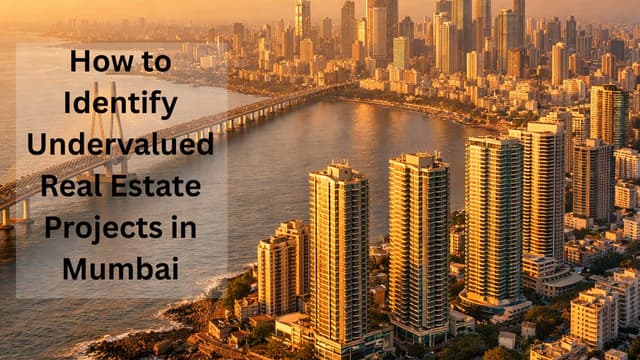
Mumbai's real estate market is known for high property prices, limited land availability and strong demand in well-connected locations. However, not every property project in the city comes with a premium price for the right reasons. Some projects may be priced below similar properties in the surrounding area because of genuine limitations, while others may simply be overlooked by buyers.
For property investors, identifying an undervalued real estate project in Mumbai can create an opportunity to enter the market at a relatively attractive price and benefit if the locality, infrastructure or project itself improves over time.
The challenge is knowing the difference between a genuinely undervalued property and a project that is cheap because it has serious problems. A low price alone does not make a property a good investment. Buyers need to look at the location, developer, construction quality, legal records, connectivity, rental demand and future development before making a decision.
What Does an Undervalued Property Project Mean?
An undervalued real estate project is generally a property that appears to be priced lower than what comparable properties in the same or nearby area are selling for, despite having similar or potentially improving features.
For example, suppose several new residential projects in a particular Mumbai suburb are priced within a similar range, while one project is available at a noticeably lower rate. This difference deserves investigation.
There could be a simple reason, such as the project being newly launched, having fewer amenities or being slightly farther from a major road. On the other hand, the lower price could be linked to construction delays, poor access, legal concerns or weak demand.
The objective is therefore not to find the cheapest property in Mumbai. It is to find a property where the current price does not fully reflect its potential and where the risks are manageable.
Compare Property Prices Within the Same Locality
One of the first steps in identifying undervalued real estate projects in Mumbai is comparing prices within the same micro-market.
Mumbai property prices can vary significantly even between neighbouring areas. A project located close to a railway station, metro corridor, business district or major road may command a higher price than another project just a few kilometres away.
Instead of comparing a property with the entire Mumbai market, buyers should examine similar projects in the immediate area.
Compare:
Price per square foot
Apartment size
Age of the building
Distance from transport facilities
Developer reputation
Amenities
Parking availability
Construction quality
Possession status
Maintenance costs
Rental demand
If a project is substantially cheaper than comparable properties but offers similar features, it may deserve closer attention.
Look Beyond the Mainstream Property Locations
Popular Mumbai locations naturally attract more attention from buyers. Areas around established business districts, major railway stations and premium residential neighbourhoods often command higher property prices.
However, investors looking for undervalued projects may need to look at emerging areas surrounding established locations.
Neighbourhoods undergoing improvements in roads, public transport, commercial development or social infrastructure can sometimes attract buyers before prices fully reflect those changes.
This does not mean every developing locality will automatically experience strong price growth. Investors should examine whether the planned infrastructure is actually progressing and whether people are already choosing to live and work in the area.
The important question is: Is the area improving in a way that can create genuine housing demand?
Study Upcoming Infrastructure Carefully
Infrastructure is one of the major factors that can influence Mumbai property prices. New or improved transport links can reduce travel time and make previously less-preferred locations more convenient.
When evaluating a potentially undervalued project, research nearby infrastructure such as:
Metro routes and stations
Railway connectivity
Major roads and highways
Bridges and road expansion
Business districts
Schools and colleges
Hospitals
Shopping and entertainment facilities
Planned commercial developments
However, buyers should not pay a premium simply because a developer or broker mentions a future infrastructure project.
Check the actual status of the project. A completed or actively progressing infrastructure project carries a different level of certainty from an idea that has only been proposed.
Check the Developer's Track Record
A lower price is of little value if the project comes with significant execution risks.
The developer's past record should therefore be one of the first checks before investing in a seemingly undervalued project.
Look at the developer's previous projects and examine whether they were completed on time, whether buyers faced major complaints and whether the finished properties match what was originally promised.
A developer with a history of delivering projects can provide greater confidence than an unknown developer offering an unusually low price.
Buyers should also verify the project's registration and other relevant details through official records before making financial commitments.
Check the Property's Rental Potential
An undervalued property does not necessarily need to be purchased only for future price appreciation. Rental demand can provide another useful indicator of whether a project has real market value.
Look at the type of people living and working in the surrounding area.
Locations close to offices, educational institutions, hospitals, transport hubs and commercial centres may have a broader tenant base.
Compare the expected rent with the total cost of purchasing the property. A project that is affordable to buy but difficult to rent out may not be as attractive to an investor as its price initially suggests.
It is also useful to speak with local brokers and property managers to understand how quickly similar homes are rented and what tenants typically look for.
Investigate Resale Demand
An investor should not only ask whether a property is affordable today. The bigger question is whether another buyer is likely to want it in the future.
Resale demand depends on several practical factors.
A property with good connectivity, a functional layout, reasonable maintenance costs and access to everyday facilities may have a wider pool of potential buyers.
On the other hand, a very cheap apartment in an inconvenient location may remain difficult to sell even after several years.
Before buying, check how frequently similar properties are being listed and sold in the area. Speaking to multiple local brokers rather than relying on one salesperson can provide a broader picture.
Pay Attention to Project Size and Supply
Mumbai has several micro-markets where numerous residential projects compete for the same buyers and tenants.
If a locality has a large number of new apartments coming up at the same time, investors should examine whether future supply could make resale more difficult.
A project can look inexpensive today but remain inexpensive if buyers have many similar options available.
Limited supply, on the other hand, can sometimes support demand when the location has strong employment, transport and social infrastructure.
The key is to understand the balance between the number of homes being built and the number of people likely to need them.
Look at the Apartment Layout, Not Just the Price
Two apartments with the same carpet area can have very different practical value.
A poorly designed home may have large areas that are difficult to use, limited natural light or an inconvenient room arrangement.
When comparing projects, physically inspect the apartment wherever possible.
Check:
Carpet area
Room sizes
Natural light
Ventilation
Balcony usability
Kitchen layout
Storage space
Number and location of bathrooms
View from the apartment
Noise levels
Floor height
A well-planned apartment in a slightly less fashionable project can sometimes offer better practical value than a more expensive apartment with a less useful layout.
Check Construction Quality and Maintenance Costs
Buyers often focus heavily on the purchase price and overlook the cost of maintaining the property.
A project with impressive amenities may have higher monthly maintenance expenses. Swimming pools, large clubhouses, landscaped gardens and other facilities can increase the ongoing cost of ownership.
Check the quality of common areas, lifts, plumbing, electrical systems and other essential facilities.
For an older project, find out whether major repairs are expected in the coming years.
An apartment that looks undervalued at the time of purchase may become expensive if substantial repair or renovation costs arise soon after buying.
Verify Legal and Property Documents
This step should never be skipped simply because a project appears attractively priced.
Before making a purchase, buyers should verify the relevant property and project documents and seek professional legal advice where necessary.
Check details relating to:
Project registration
Ownership of the land
Development permissions
Building approvals
Sale agreement
Carpet area
Possession status
Outstanding dues
Encumbrances or disputes
Society-related records, where applicable
A property with an unusually low price but unresolved legal issues is not the same as an undervalued property.
Talk to Existing Residents
For completed or occupied projects, existing residents can provide information that may not appear in advertisements.
Ask residents about water supply, lift maintenance, security, noise, parking, construction quality, society management and other everyday issues.
This can help reveal the difference between the property's marketing image and the actual living experience.
For investors, residents can also provide useful insights into tenant demand and resale activity.
Calculate the Total Cost Instead of Comparing Only the Base Price
A project may appear cheaper when only the advertised property price is considered.
Buyers should calculate the complete purchase cost, including applicable registration-related expenses, taxes, parking charges, maintenance deposits, interior work, brokerage and other charges.
This gives a more realistic comparison between competing projects.
For example, a slightly more expensive property with fewer additional costs may ultimately require a similar amount of money as a cheaper property with several extra charges.
Use a Simple Undervaluation Checklist
Investors can create a basic comparison sheet before shortlisting a project.
Give each property a detailed review based on:
Local property price
Connectivity
Future infrastructure
Developer history
Construction quality
Rental demand
Resale demand
Legal documentation
Apartment layout
Total purchase cost
Future supply in the locality
Everyday social infrastructure
The purpose of such a checklist is not to produce a complicated score. It is to make sure that a low price is supported by several positive factors rather than one attractive feature.
Be Careful With "Distress Sale" and "Limited Period" Claims
Property buyers in Mumbai may come across advertisements claiming urgent sales, distress prices or limited-period offers.
Such opportunities can occasionally be genuine, but buyers should not make decisions solely because they fear missing out.
Ask why the seller is offering the property below the prevailing price. If the reason is personal financial need and the property documents are clear, the situation is different from a property being sold cheaply because of serious problems.
Always verify the actual transaction value of comparable properties instead of relying only on advertised prices.
Consider the Holding Period
An undervalued project may not deliver immediate results.
Some properties become more attractive only after surrounding infrastructure develops, the project becomes
An undervalued project may not deliver immediate results.
Some properties become more attractive only after surrounding infrastructure develops, the project becomes fully occupied or the locality gains better commercial and social facilities.
Investors should therefore consider how long they are prepared to hold the property.
Someone looking for a quick resale opportunity may have different requirements from a buyer willing to hold the property for several years and earn rental income along the way.
Don't Confuse Cheap Property With Undervalued Property
The distinction is important in Mumbai's real estate market.
A cheap property may have a low price because buyers do not want it. An undervalued property may have a low price because the market has not fully recognised its potential or because it is temporarily overlooked.
The difference can only be understood through research.
The strongest signs to investigate are usually a reasonable price compared with nearby projects, improving connectivity, genuine end-user demand, a reliable developer, clean documentation and a location with practical reasons for future demand.
For property investors, the search for an undervalued real estate project in Mumbai should therefore begin with understanding why the property is cheap, rather than simply asking how cheap it is. That distinction can help separate genuine opportunities from properties where the lower price reflects risks that may continue for years.
India’s real estate market continues to transform alongside infrastructure expansion, urban development, and changing homebuyer expectations. As new residential corridors and growth micro-markets emerge, opportunities are expanding beyond traditional city centres. Buyers and investors who track infrastructure projects, connectivity improvements, and planned urban growth are better positioned to identify high-potential locations and maximise long-term property value. Whether the objective is buying a home for self-use or building a diversified real estate investment portfolio, success depends on choosing the right location, entering at the right time, and making well-informed decisions. Evaluating neighbourhood development trends, selecting legally compliant and transparent projects, and aligning property purchases with long-term financial and lifestyle goals can significantly improve overall returns and ownership satisfaction. As the sector continues to mature, real estate remains one of the most stable long-term investment options. With careful planning, market awareness, and strategic decision-making, property investments made today can support wealth creation, financial security, and sustainable lifestyle growth in the years ahead.
- Verified Tenants/Buyers
- Unlimited Property Listing
- Zero subscription/charges fee