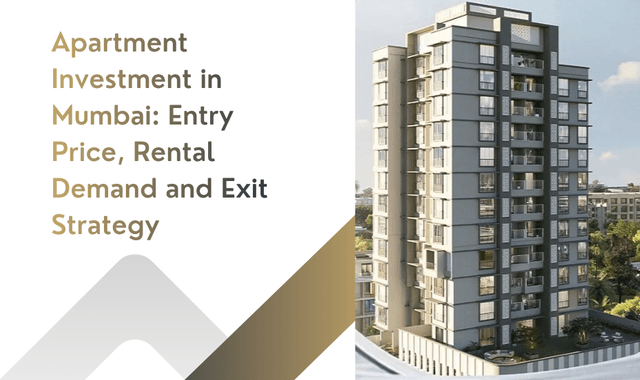
Mumbai’s real estate market has long been driven by limited land, strong employment opportunities, infrastructure development and steady demand for housing. But for buyers and investors, one question remains important: Mumbai apartment market vs plot market.
The answer depends largely on what the buyer wants from the property. Apartments offer a more organised buying process, established residential demand and relatively easier financing, while plots provide land ownership and greater flexibility but often involve higher due-diligence requirements and limited availability within Mumbai city.
Recent market data shows that residential demand across the Mumbai Metropolitan Region (MMR) remains substantial. According to ANAROCK, MMR recorded around 1.27 lakh housing sales in 2025, against approximately 1.26 lakh new launches. The average capital value reached about ₹17,350 per sq ft, up around 5% over the previous year.
This backdrop is important when comparing apartments with plots.
Apartment Demand Remains Broad-Based Across Mumbai
Apartments dominate Mumbai's residential market largely because they match the way the city has developed. With land in established locations being scarce and expensive, vertical housing has become the practical solution for accommodating a growing population.
The demand is not restricted to luxury apartments in South Mumbai or premium homes in established suburbs. Affordable and mid-range housing continues to account for a significant portion of activity, particularly in peripheral parts of the MMR.
ANAROCK's 2025 data shows that homes priced below ₹40 lakh accounted for 34% of MMR's new launches, while the ₹40 lakh-₹80 lakh segment represented another 24%. This indicates that a substantial part of new supply continues to target buyers looking for relatively accessible housing.
Apartments also benefit from the fact that buyers can purchase them for different purposes. A salaried professional may buy a two-bedroom home for personal use, a family may upgrade to a larger apartment, while an investor may look for rental income or long-term capital appreciation.
This wide buyer base gives apartments a relatively broad market.
Why Plots Are Different in Mumbai
Plots operate under a very different set of conditions.
In the core areas of Mumbai, vacant residential land is extremely limited. As a result, an ordinary buyer looking for an independent residential plot within established Mumbai neighbourhoods may find far fewer options compared with apartments.
Plot opportunities become more visible as one moves towards the wider MMR, including developing areas around Navi Mumbai, Panvel, Palghar, Thane's outskirts and other peripheral locations. However, these markets need to be evaluated individually rather than treating the entire MMR plot market as one segment.
The attraction of a plot is straightforward: the buyer owns the land and is not tied to the design or amenities of a particular apartment project. Over the long term, land in a location that experiences substantial development can become valuable as roads, transport links, commercial activity and housing projects expand around it.
However, the challenge is that the value of a plot depends heavily on its exact location and legal status.
Apartments Have an Advantage in Liquidity
One of the biggest differences between the two markets is liquidity essentially, how easily an owner can find another buyer.
Apartments in established Mumbai locations have a large pool of potential buyers. People looking for a home generally search for apartments because they are readily available across different budgets and configurations.
The transaction process is also more familiar to banks, brokers and buyers.
The strength of this demand was visible in Mumbai's registration activity during 2025. Mumbai recorded more than 15,600 property registrations in March 2025, with residential properties accounting for around 80% of registrations, according to data reported from the Inspector General of Registration and analysed by Knight Frank.
Plots can also be sold successfully, but the buyer pool can be narrower. A plot purchaser may want to build a house, hold the land for several years or develop it commercially, depending on zoning and permissions.
That makes the resale process more dependent on the property's location, title, permitted use and development potential.
Infrastructure Is Changing the Plot Story
Infrastructure development is one area where plots can attract considerable attention.
New roads, highways, metro lines, rail connectivity and large infrastructure projects can gradually change the attractiveness of peripheral locations. When connectivity improves, areas that were previously considered too far from established employment centres can become more accessible.
ANAROCK has identified infrastructure projects such as the Mumbai Trans Harbour Link and Coastal Road as factors supporting new residential corridors across the MMR. The report also points to increased redevelopment activity and land acquisition by developers as important features of the region's longer-term housing story.
For plot buyers, such changes can be particularly relevant because undeveloped land may have more room for transformation than an already-developed apartment building.
But infrastructure announcements should not automatically be treated as a guarantee of higher land prices. The actual benefit depends on whether the project is completed, how close the plot is to the new infrastructure and whether the surrounding area develops as expected.
Apartments Offer More Immediate Usability
For buyers who want to use the property immediately, apartments generally offer a simpler proposition.
A completed apartment can provide immediate occupation, while an under-construction project may offer a defined timeline for possession. Buyers also get access to common facilities such as parking, security, lifts and recreational areas depending on the project.
In Mumbai, where commuting time is a major consideration, the location of an apartment can be particularly important. A home close to employment hubs, metro stations, railway stations, schools and shopping areas may attract consistent end-user demand.
Recent data also shows that Mumbai's apartment market is not limited to very small homes. While nearly half of properties registered in 2024 had a carpet area below 650 sq ft, the supply of apartments between 650 sq ft and 1,300 sq ft had almost doubled over four years, according to MahaRERA data reported by Hindustan Times.
This suggests that developers are catering to different household requirements rather than focusing on only one apartment size.
Plots Can Offer Greater Flexibility
The strongest argument for buying a plot is flexibility.
An apartment buyer generally accepts the building design, floor plan, common areas and development rules established by the developer or housing society. A plot owner, subject to local regulations and approvals, has greater control over what is eventually built.
For example, a buyer purchasing a legally developable residential plot may eventually construct an independent house rather than buying a ready-made apartment.
Plots can also appeal to investors who do not require immediate rental income and are prepared to hold the property for a longer period.
However, this flexibility comes with responsibilities. Buyers need to verify the title, land classification, development permissions, access road, encumbrances, zoning restrictions and applicable local regulations before purchasing.
A seemingly inexpensive plot can become expensive if there are legal disputes, access problems or restrictions on construction.
Financing Is Another Important Difference
Financing can also influence the apartment-versus-plot decision.
Home loans for apartments are a familiar product for banks and housing finance companies. Buyers purchasing approved projects from established developers may find the documentation and financing process relatively straightforward, subject to their financial profile and the property's eligibility.
Plot financing can be more complicated. Lenders may have different requirements for residential land loans, and some plots may not qualify depending on location, title, land use and documentation.
This means buyers should not compare only the purchase price. They should also examine the down payment, loan availability, interest cost, registration expenses, construction cost and holding period.
For someone buying a plot with the intention of building later, the eventual construction expense can significantly increase the total investment.
Mumbai Apartments Have a Wider End-User Market
The apartment market also benefits from Mumbai's continuing preference for compact, connected homes.
In Q2 2025, MMR recorded approximately 31,300 housing sales, while peripheral areas accounted for 46% of sales. Mumbai city itself contributed around 70% of total MMR sales when looking at the four broad regions tracked by ANAROCK.
This distribution highlights an important point: residential demand is spreading beyond the traditional core areas.
For apartment buyers, that creates a wider choice of locations. A buyer can compare established suburbs with emerging areas based on budget, commute and lifestyle requirements.
For plot buyers, the same expansion creates opportunities, but it also means that location selection becomes even more important.
The Price Question Needs a Location-by-Location Approach
Comparing apartment prices with plot prices on a simple per-square-foot basis can be misleading.
An apartment price usually reflects not only the land but also construction, common facilities, building services, parking and the cost of developing the project.
A plot price, on the other hand, is primarily linked to the land itself, although factors such as development rights, location, access and permissible construction can have a major impact.
For example, a plot in an emerging peripheral corridor may appear inexpensive compared with an apartment in an established Mumbai suburb. But the two properties may serve completely different purposes.
The apartment could provide immediate housing and rental potential, while the plot may require years of holding before the surrounding area reaches a more mature stage.
Which Market Has Stronger Demand?
Current market data points to apartments having the broader and more established demand base, particularly for end-use housing across Mumbai and the wider MMR. Sales volumes, new launches and registrations demonstrate substantial ongoing activity in the residential apartment segment.
The plot market, meanwhile, is more location-specific. Its prospects can be closely linked to infrastructure, land availability, zoning and future development around a particular parcel.
This does not mean every apartment will perform well or every plot will appreciate. In both categories, the exact location, purchase price, legal documentation and development potential can make a significant difference.
For buyers considering the Mumbai apartment market vs plot market, the practical choice therefore comes down to the purpose of the purchase. An apartment may fit someone seeking an immediately usable home, established neighbourhood infrastructure and a wider resale market.
India’s real estate market continues to transform alongside infrastructure expansion, urban development, and changing homebuyer expectations. As new residential corridors and growth micro-markets emerge, opportunities are expanding beyond traditional city centres. Buyers and investors who track infrastructure projects, connectivity improvements, and planned urban growth are better positioned to identify high-potential locations and maximise long-term property value. Whether the objective is buying a home for self-use or building a diversified real estate investment portfolio, success depends on choosing the right location, entering at the right time, and making well-informed decisions. Evaluating neighbourhood development trends, selecting legally compliant and transparent projects, and aligning property purchases with long-term financial and lifestyle goals can significantly improve overall returns and ownership satisfaction. As the sector continues to mature, real estate remains one of the most stable long-term investment options. With careful planning, market awareness, and strategic decision-making, property investments made today can support wealth creation, financial security, and sustainable lifestyle growth in the years ahead.
- Verified Tenants/Buyers
- Unlimited Property Listing
- Zero subscription/charges fee