Buying an apartment in Mumbai is a major financial decision that requires careful planning. While most home buyers focus on the purchase price, location, amenities and loan affordability, another important factor deserves equal attention: the property's resale value. Whether a buyer plans to live in the apartment for several years or purchase it as an investment, understanding its future resale potential can help protect the money invested.
Mumbai's property market is influenced by several factors, including infrastructure development, employment opportunities, connectivity, neighbourhood facilities and changing buyer preferences. Two apartments in the same locality may have significantly different resale values depending on their building condition, layout, floor level, maintenance standards and legal status. Therefore, choosing a property only because it fits the current budget may not always be the right decision.
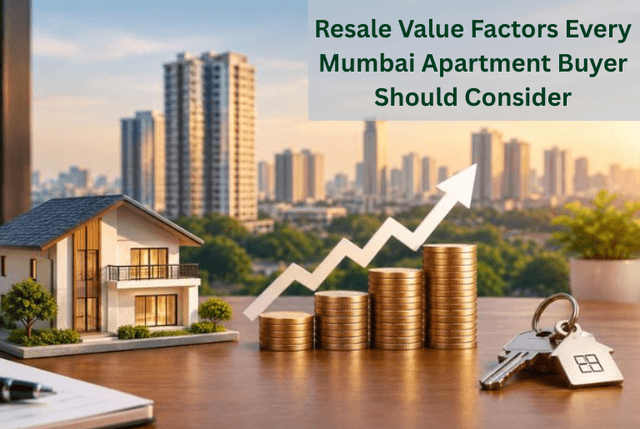
For buyers planning to purchase residential property in Mumbai, evaluating resale value from the beginning can help them make a more informed choice. Here are some important resale value factors every Mumbai apartment buyer should consider before finalising a property.
1. Location Plays a Major Role in Resale Value
Location remains one of the strongest factors influencing apartment resale value in Mumbai. A property in a well-connected neighbourhood with access to workplaces, schools, hospitals, shopping centres and public transport is generally more attractive to future buyers.
Localities such as Andheri, Powai, Chembur, Ghatkopar, Kandivali, Thane and Navi Mumbai attract different categories of home buyers because of their residential facilities and connectivity. However, the resale potential of an apartment also depends on its exact location within a neighbourhood.
For example, an apartment located close to a railway station, metro station or major road may attract more interest than a similar property situated far from public transport. Likewise, properties in peaceful residential lanes may appeal to families looking for a comfortable living environment.
Buyers should also examine the area's future development plans. Upcoming roads, metro routes, commercial centres and other infrastructure projects may improve accessibility and increase residential demand over time. However, it is important to check whether these projects are approved, under construction or still being proposed before considering their impact on future property prices.
2. Connectivity to Public Transport and Major Roads
Mumbai's daily travel challenges make connectivity an important consideration for home buyers. People often prefer apartments that reduce commuting time and provide convenient access to offices, business districts and other important destinations.
Properties located near railway stations, metro corridors, bus routes and major roads can have an advantage in the resale market. Good connectivity makes an apartment suitable for a wider group of buyers, including working professionals, families and people who regularly travel across the city.
For instance, an apartment with convenient access to the Western Railway line may attract buyers working in Andheri, Goregaon, Malad or nearby commercial areas. Similarly, properties with access to the Central Railway network or metro services may appeal to people travelling towards other parts of Mumbai.
Buyers should consider the actual travel time rather than simply relying on the distance mentioned in property advertisements. Road congestion, walking distance, traffic conditions and public transport frequency can affect everyday convenience.
3. Reputation and Condition of the Building
The condition of the residential building has a direct influence on its resale appeal. Even if an apartment is spacious and located in a popular neighbourhood, buyers may hesitate if the building is poorly maintained.
Common areas such as staircases, lifts, entrance lobbies, parking areas, gardens and passageways contribute to the overall impression of a residential property. A building with clean surroundings, working lifts, proper security and regular maintenance is likely to attract greater buyer interest.
The reputation of the housing society also matters. Buyers generally prefer societies that maintain proper financial records, follow maintenance schedules and address residents' concerns.
Before purchasing an apartment, check the building's age, structural condition and history of major repairs. Older buildings may require significant renovation work, which could affect their resale value. It is also useful to understand whether the society has sufficient funds for regular maintenance and future repairs.
A well-maintained building can remain attractive to buyers even as it gets older, while poor upkeep may reduce its market appeal.
4. Apartment Size and Practical Layout
The size of an apartment is another important factor affecting its resale value. However, a larger property does not automatically guarantee a better resale price. The usability of the available space is equally important.
In Mumbai, where residential space is often expensive, buyers look for apartments that make efficient use of every square foot. A well-designed 2 BHK apartment with properly sized bedrooms, a functional kitchen, sufficient storage and good ventilation may attract more interest than a larger apartment with an inconvenient layout.
The demand for 1 BHK, 2 BHK and 3 BHK apartments also varies across localities. Compact apartments may appeal to young professionals and first-time buyers, while larger homes may attract growing families and buyers seeking additional space.
Before booking an apartment, examine the carpet area rather than depending only on the advertised apartment size. Carpet area gives a clearer idea of the usable space available inside the home.
Also consider the placement of bedrooms, bathrooms, balconies and the kitchen. Unusual layouts, narrow passages and poorly positioned rooms may make a property less appealing to future buyers.
5. Floor Level, Natural Light and Ventilation
The floor on which an apartment is located can influence its resale potential. Some buyers prefer higher floors because they offer better views, greater privacy and reduced disturbance from street-level activities. Others prefer lower floors because they provide easier access and may be more convenient for senior citizens and families with young children.
The availability of working lifts, emergency facilities and reliable power backup can also influence buyers' preferences, particularly in high-rise residential buildings.
Natural light and ventilation are equally important. Apartments that receive sufficient daylight and have good airflow generally provide a more comfortable living environment. Homes facing open spaces, gardens or less congested surroundings may attract greater interest than apartments facing closely packed buildings.
Buyers should visit the property at different times of the day to understand the amount of sunlight it receives. They should also check for noise from nearby roads, commercial establishments or construction activities.
These details may appear minor during the purchase process, but they can influence how easily an apartment attracts future buyers.
6. Parking Availability and Society Amenities
Parking has become an important consideration for residential property buyers in Mumbai. With limited parking space in many neighbourhoods, an apartment with convenient and clearly documented parking arrangements may have an advantage in the resale market.
Buyers should verify whether the parking facility is allotted by the housing society, included in the agreement or available under another legally recognised arrangement. They should not rely only on verbal assurances from the seller or broker.
Society amenities can also influence resale demand. Facilities such as security systems, lifts, landscaped gardens, children's play areas, fitness centres, swimming pools and community halls can make a residential project more attractive.
However, buyers should distinguish between useful amenities and facilities that simply increase maintenance expenses. A project with several luxury amenities may charge higher monthly maintenance fees, which could discourage budget-conscious buyers.
The quality, condition and regular upkeep of amenities are more important than the number of facilities advertised by the developer.
7. Legal Clearances and Property Documentation
Clear legal documentation is essential for maintaining an apartment's resale value. Buyers may find it difficult to sell a property if ownership records are incomplete, approvals are missing or there are disputes involving the apartment or building.
Before purchasing a resale apartment, verify the seller's ownership documents, previous sale agreements, property registration records and society-related documents. It is also important to check whether the property has any outstanding home loan, legal dispute or financial liability.
For apartments in newer buildings, buyers should examine the project's MahaRERA registration details, where applicable, and verify the relevant approvals.
A property with clear ownership and complete documentation generally provides greater confidence to future buyers and lenders. Therefore, legal verification should be treated as an important part of resale value planning rather than just a formality.
8. Age of the Property and Redevelopment Potential
The age of an apartment building can influence its resale value, particularly in established areas of Mumbai. Newer buildings may attract buyers because they offer modern layouts, updated facilities and fewer immediate repair requirements.
However, older properties in prime locations can also have strong resale demand. In certain neighbourhoods, established buildings may offer larger room sizes, convenient locations and access to well-developed social infrastructure.
Redevelopment potential is another factor that buyers may consider when evaluating older residential properties. Mumbai has several ageing residential buildings where redevelopment can create opportunities for existing residents.
However, redevelopment should never be treated as a guaranteed benefit. Buyers must examine the building's condition, land ownership, society's redevelopment discussions, developer proposals and legal approvals.
An apartment in an ageing building without a clear redevelopment plan may involve higher maintenance costs and uncertainty. Therefore, buyers should evaluate the property's present condition rather than paying an additional amount based only on the possibility of future redevelopment.
9. Maintenance Charges and Society Management
Monthly maintenance charges may not appear significant when compared with the overall apartment price, but they can influence future resale demand.
High maintenance expenses increase the monthly cost of owning a home. Buyers considering an apartment in a premium residential project may be comfortable with higher charges if the facilities and services justify the expense. However, many middle-income buyers prefer properties with reasonable maintenance costs.
Before purchasing an apartment, ask the seller for recent maintenance bills and check whether there are any outstanding payments.
It is also useful to understand how the society manages its finances. Regular maintenance, transparent accounting, timely repairs and organised management can improve residents' confidence in the building.
A poorly managed society may face problems such as delayed repairs, disputes among residents and deterioration of common facilities. These issues can affect the property's appeal when it is put up for resale.
10. Demand for Apartments in the Locality
The resale value of an apartment is closely connected to the demand for similar properties in its neighbourhood. A locality may have attractive property prices, but limited buyer interest can make it difficult to sell an apartment quickly.
Buyers should study the types of homes that are commonly purchased in the area. For example, localities with a large working population may have stronger demand for compact 1 BHK and 2 BHK apartments. Areas popular with established families may see greater interest in larger homes.
It is also important to examine the number of similar apartments available for sale. If several owners are trying to sell comparable properties in the same building or neighbourhood, buyers may have more choices and greater negotiating power.
Checking recent registered transactions can provide a better understanding of actual market prices. Property advertisements may show asking prices, but the final transaction value can be different.
11. Quality of Nearby Social Infrastructure
The availability of essential facilities around an apartment can influence its long-term resale potential. Families generally prefer residential locations with access to schools, hospitals, supermarkets, banks, parks and other daily conveniences.
For working professionals, proximity to office districts, business parks and commercial centres may be an important consideration. For families with children, access to educational institutions and recreational spaces can make a locality more attractive.
Mumbai neighbourhoods with established social infrastructure often appeal to buyers because residents do not have to travel long distances for everyday requirements.
Buyers should also check the condition of nearby roads, drainage systems, street lighting and public spaces. Areas with frequent waterlogging, poor road conditions or inadequate civic facilities may face challenges in attracting future buyers.
The availability of open spaces and recreational facilities can further improve a neighbourhood's residential appeal.
12. Water Supply, Power Backup and Other Essential Services
Basic facilities play an important role in the everyday experience of apartment owners. A property with an unreliable water supply, frequent power interruptions or poor waste management may struggle to attract buyers, regardless of its location.
Water availability is particularly important in certain parts of Mumbai and its surrounding residential markets. Buyers should ask whether the building receives a regular municipal water supply and whether additional arrangements, such as water tankers, are required.
Power backup for lifts and common areas is another useful facility, especially in high-rise buildings. Proper waste disposal, functioning drainage systems and regular pest control also contribute to a comfortable residential environment.
During a property visit, buyers should speak with existing residents or society representatives to understand whether the building regularly faces these problems.
Understanding these practical details can help buyers avoid properties that may involve recurring expenses or difficulties in the future.
13. Builder Reputation and Construction Quality
The developer's reputation can influence the resale appeal of apartments, particularly in newly constructed residential projects. Buyers often feel more confident purchasing homes in projects developed by builders known for timely delivery, transparent documentation and consistent construction quality.
A builder's previous projects can provide useful information about construction standards, maintenance requirements and the quality of facilities provided to residents.
Construction quality should also be examined carefully. Poor finishing, water leakage, cracks, plumbing issues and electrical problems can increase repair expenses and reduce the property's attractiveness.
Buyers should inspect the apartment thoroughly and consider getting a professional property inspection, particularly when purchasing an older resale unit.
A home that requires fewer immediate repairs is generally easier to present to potential buyers when the owner decides to sell it.
14. Purchase Price Compared with Current Market Rates
The price paid at the time of purchase plays an important role in determining the potential resale return. Even an apartment in a desirable location may not deliver an attractive financial outcome if it is purchased at an unusually high price.
Buyers should compare the quoted rate with recent transactions involving similar apartments in the same neighbourhood. Factors such as floor level, building age, parking, carpet area, renovation and amenities should be considered while making comparisons.
It is also important to account for additional purchase expenses, including stamp duty, registration charges, brokerage, legal fees, home loan processing charges and interior work.
For example, if an apartment is purchased at a price significantly higher than comparable properties, the owner may find it difficult to recover the total investment through resale, even if property prices increase gradually.
Negotiating a reasonable purchase price can provide greater financial flexibility when selling the apartment later.
15. Changing Buyer Preferences and Future Housing Demand
Home-buying preferences continue to change as lifestyles, family structures and work arrangements evolve. Apartments that meet current and future residential requirements may attract a wider range of buyers.
For example, many buyers now look for dedicated work-from-home spaces, practical storage areas, balconies, security systems and better community facilities. Families may also prefer homes with additional bathrooms, functional kitchens and comfortable bedroom sizes.
Environmental features such as rainwater harvesting, energy-efficient lighting, proper waste management and landscaped open spaces are also gaining attention among some home buyers.
Apartments that offer practical features without unnecessarily increasing maintenance expenses may remain attractive to different buyer groups.
Buyers should consider whether the property can meet changing household requirements over the next five to ten years. A flexible layout, convenient location and well-maintained building can help preserve its appeal in a changing residential market.
16. Rental Demand as an Additional Resale Value Indicator
Rental demand can provide useful information about the attractiveness of a residential property. Apartments located near employment centres, educational institutions, hospitals and transport facilities may attract tenants as well as potential buyers.
A property with consistent rental demand can offer an additional income opportunity while the owner holds it as a long-term investment.
For instance, apartments in areas such as Powai, Andheri, Goregaon and parts of Thane may appeal to working professionals because of their access to commercial and employment hubs. However, rental demand varies by building, apartment configuration and exact location.
Buyers should compare the expected monthly rent with the purchase price and calculate the approximate annual rental yield. They should also account for maintenance charges, property taxes, vacancy periods and repair expenses.
A property with reasonable rental potential may provide greater flexibility if the owner needs to relocate before deciding to sell.
17. Future Infrastructure Development Around the Property
Infrastructure development can influence the long-term attractiveness of residential locations in Mumbai. New metro connections, road improvements, railway upgrades and transport links may make previously less-connected neighbourhoods more accessible.
Improved connectivity can increase interest among home buyers who want to reduce travel time and access different parts of the city more easily.
However, buyers should avoid paying a premium based entirely on future infrastructure announcements. Some projects may take several years to become operational, while others may face delays or changes in their planned routes.
It is important to examine the current stage of the project and its likely impact on the apartment's actual accessibility.
Buyers should also consider whether new infrastructure could bring additional traffic, noise or construction-related inconvenience to the immediate neighbourhood.
Evaluating both the benefits and possible drawbacks of development projects can help buyers make a more balanced property purchase decision.
18. Availability of Similar Properties and Future Competition
The supply of residential apartments in a locality can affect resale prices. If a neighbourhood has a large number of similar apartments available for sale, sellers may face greater competition when they decide to exit their investment.
This is particularly relevant in areas experiencing significant residential construction.
This is particularly relevant in areas experiencing significant residential construction. New projects may offer modern amenities, attractive payment plans and updated apartment designs, making older properties compete for buyer attention.
However, established buildings may still have advantages such as better locations, larger usable spaces and developed neighbourhood facilities.
Before purchasing, buyers should examine upcoming residential supply and compare the apartment with both existing resale properties and newly launched projects.
Understanding the competition can help buyers identify properties with features that are difficult to find elsewhere in the locality.
19. Ease of Selling the Property in the Future
Resale value is not determined only by the price an apartment can command. The time and effort required to find a suitable buyer are also important.
Properties with clear documentation, practical layouts, convenient locations and reasonable maintenance expenses generally appeal to a wider group of buyers.
An apartment with an unusual configuration, very high monthly charges or unresolved legal issues may take longer to sell, even if the owner is willing to negotiate.
Buyers should also consider whether the property is suitable for different categories of purchasers, including first-time home buyers, families, working professionals and property investors.
A home that meets the needs of several buyer groups may offer better resale flexibility than one designed for a very narrow segment of the market.
20. Property Taxes and Other Ongoing Ownership Costs
The ongoing cost of owning an apartment can also influence its resale appeal. Property taxes, society maintenance charges, repair expenses, parking fees and other recurring payments contribute to the total cost of homeownership.
Before purchasing a resale apartment, buyers should verify whether the seller has cleared all outstanding property tax and society maintenance payments.
They should also understand whether the building is likely to require major repairs in the coming years. Expenses related to waterproofing, lift replacement, painting, plumbing and structural repairs may increase the financial burden on apartment owners.
A property with manageable ownership costs can attract buyers who are comparing several apartments within the same budget.
When evaluating resale potential, buyers should therefore consider not only the apartment's purchase price but also the expenses involved in maintaining it over the long term.
India’s real estate market continues to transform alongside infrastructure expansion, urban development, and changing homebuyer expectations. As new residential corridors and growth micro-markets emerge, opportunities are expanding beyond traditional city centres. Buyers and investors who track infrastructure projects, connectivity improvements, and planned urban growth are better positioned to identify high-potential locations and maximise long-term property value. Whether the objective is buying a home for self-use or building a diversified real estate investment portfolio, success depends on choosing the right location, entering at the right time, and making well-informed decisions. Evaluating neighbourhood development trends, selecting legally compliant and transparent projects, and aligning property purchases with long-term financial and lifestyle goals can significantly improve overall returns and ownership satisfaction. As the sector continues to mature, real estate remains one of the most stable long-term investment options. With careful planning, market awareness, and strategic decision-making, property investments made today can support wealth creation, financial security, and sustainable lifestyle growth in the years ahead.
- Verified Tenants/Buyers
- Unlimited Property Listing
- Zero subscription/charges fee