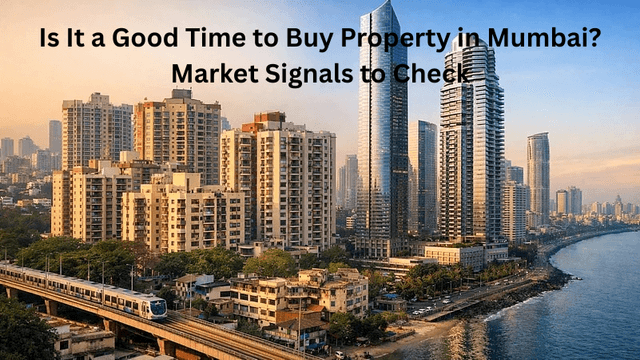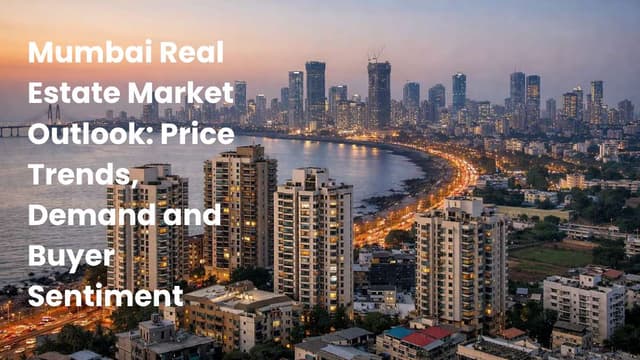
Mumbai’s property market has entered another phase of expansion, with prices rising across several established and emerging residential corridors. While the city has always commanded a premium because of limited land and strong housing demand, the latest price movement is being driven by a wider set of factors. Better transport links, major infrastructure projects, redevelopment, proximity to employment hubs and changing homebuyer preferences are reshaping the residential map of Mumbai and the wider Mumbai Metropolitan Region (MMR).
The trend is particularly visible in corridors connected to major roads, Metro lines, business districts, airports and large redevelopment projects. According to ANAROCK’s Q1 2026 residential market report, average residential capital values across the MMR rose by about 5% over the preceding year, reaching around ₹17,350 per sq ft in 2025. The region also remained one of India's largest residential markets, accounting for around 32% of new housing launches during Q1 2026.
- Verified Tenants/Buyers
- Unlimited Property Listing
- Zero subscription/charges fee
Infrastructure Is Changing the Value of Location
One of the biggest reasons behind rising property prices in Mumbai is the rapid expansion of the city’s infrastructure network.
For years, a home’s value in Mumbai was closely linked to its proximity to railway stations, major roads and employment centres. That equation is now changing. Metro corridors, the Mumbai Trans Harbour Link (Atal Setu), Coastal Road projects and airport connectivity are opening up areas that previously had longer travel times.
The impact can already be seen in several suburban markets. Research cited by Hindustan Times shows that residential prices in Chembur, Andheri and Goregaon increased between 26% and 32% from 2022 to Q1 2026. Chembur, for example, saw average prices rise from about ₹24,700 per sq ft in 2022 to ₹32,500 per sq ft in Q1 2026.
Better connectivity gives buyers a simple reason to consider these areas: less time spent travelling. For many Mumbai households, that can be as important as the size or design of the apartment.
Metro Expansion Is Supporting Housing Demand
The expansion of Mumbai Metro has become an important factor behind property price growth in several corridors.
Metro connectivity has strengthened the appeal of western and eastern suburban locations by making daily commuting more predictable. The opening and expansion of Metro corridors have also encouraged developers to launch projects in locations where buyers previously had concerns about accessibility.
The effect is not limited to already-established neighbourhoods. Areas such as Dahisar, Mira Road and Bhayandar are increasingly being viewed as part of Mumbai’s broader residential market rather than isolated peripheral locations.
According to ANAROCK data reported in April 2026, average residential prices increased by about 25% in Dahisar, 37% in Mira Road and 36% in Bhayandar between 2022 and Q1 2026. The same research showed a 30% rise in Andheri and Goregaon over the period.
The message for the property market is fairly straightforward: when transport improves, buyers become more willing to consider homes farther from traditional business districts.
Atal Setu Is Expanding the Mumbai-Navi Mumbai Property Corridor
The Mumbai Trans Harbour Link, popularly known as Atal Setu, has also changed the way buyers look at locations across Mumbai and Navi Mumbai.
The bridge has improved road connectivity between Sewri and Nhava Sheva, reducing the physical barrier between the two sides of the harbour. This has strengthened interest in areas such as Navi Mumbai, Panvel and parts of the surrounding region.
Infrastructure projects of this scale can influence property markets in two ways. First, they make existing residential locations easier to reach. Second, they encourage businesses, commercial activity and new housing projects to move towards newly connected areas.
The Navi Mumbai International Airport is adding another layer to this growth story. Real estate experts have identified the airport belt, including areas around Panvel and Ulwe, as an important growth corridor in the MMR.
For homebuyers, the attraction is also linked to affordability. Several locations around the airport continue to offer homes at prices that are lower than those found in established Mumbai neighbourhoods, creating room for demand from buyers who cannot afford central Mumbai.
Redevelopment Is Creating New Housing in Established Areas
Mumbai has one of the country’s most land-constrained property markets. There is limited scope for large-scale development in many established neighbourhoods. As a result, redevelopment has become a major source of new housing supply.
Older buildings, ageing housing societies and large land parcels are being redeveloped into newer residential projects. This is particularly visible in areas such as Parel, Sewri, Wadala and parts of the eastern and western suburbs.
Parel and Sewri have received additional attention following the opening of Atal Setu and the development of the Sewri-Worli connectivity corridor. Local market estimates cited by Hindustan Times put apartment prices in Parel at around ₹40,000-₹50,000 per sq ft, while Sewri is reported in the ₹20,000-₹35,000 per sq ft range.
Redevelopment can also change the character of a neighbourhood. New buildings often bring modern amenities, improved parking and better building facilities. This can encourage buyers to pay a premium for an apartment in a familiar location rather than move to a distant suburb.
Employment Hubs Continue to Support Property Prices
Mumbai’s housing market cannot be separated from its employment centres.
Areas close to major commercial districts such as Bandra-Kurla Complex, Lower Parel, Andheri and Powai continue to attract people who want to reduce their daily travel time. As businesses expand and office districts become better connected, residential demand tends to follow.
The BKC-Andheri corridor is particularly important because it combines employment opportunities with multiple transport options. Metro connectivity has strengthened links between South Mumbai, BKC and the western and eastern suburbs.
Metro Line 3 has further improved connectivity between South Mumbai and important employment areas, including BKC and the Andheri-SEEPZ belt. This kind of transport connection can make surrounding residential locations more attractive to both homebuyers and tenants.
For property owners, strong rental demand can also support higher sale prices because buyers often consider the possibility of earning rental income from their homes.
Western Suburbs Are Benefiting From Multiple Infrastructure Projects
The western suburbs remain among Mumbai’s most active residential markets. Borivali, Kandivali, Malad and Goregaon have benefited from Metro connectivity, road improvements and ongoing Coastal Road-related infrastructure.
These neighbourhoods already have established schools, hospitals, shopping areas and employment access. Infrastructure improvements are therefore adding to an existing base rather than creating demand from scratch.
The planned expansion of the Coastal Road network is expected to strengthen connectivity along the western side of Mumbai. The proposed Versova-Bhayandar stretch is being closely watched by the real estate industry because it could improve north-south movement and reduce pressure on existing road routes. The Bandra-Versova section is currently expected to be completed by March 2028, according to statements reported in June 2026.
Real estate activity is already visible along some parts of the corridor. Bandra, Juhu, Versova and Madh Island have seen new project launches and redevelopment activity linked partly to the infrastructure pipeline.
Limited Land Supply Keeps Prices Firm
Infrastructure may create new demand, but Mumbai’s limited land availability remains one of the fundamental reasons property prices stay high.
Unlike cities with large amounts of undeveloped land within their established urban areas, Mumbai has relatively little space for unrestricted expansion. Developers therefore have to work with redevelopment, smaller land parcels and peripheral expansion.
This limitation becomes particularly important when demand rises. If more buyers want homes in a particular corridor but the number of suitable plots remains limited, developers may have greater pricing power.
ANAROCK’s Q1 2026 data also shows that MMR had around 17 months of housing inventory at the end of the quarter, suggesting that supply was not excessively stretched despite a rise in available inventory.
Premium Housing Is Driving Part of the Price Rise
Another factor behind Mumbai’s property price movement is the growing contribution of premium homes to overall sales.
Across India’s eight major residential markets, homes priced above ₹1 crore accounted for 54% of residential sales in the first half of 2026, according to Knight Frank data reported in July. Mumbai recorded 47,355 housing sales during the period, remaining the largest market among the cities covered in the report.
This does not mean every Mumbai locality is experiencing the same level of price growth. Instead, it points to a market where higher-value homes are making up an increasing share of transactions.
In established locations, buyers are often willing to pay more for larger homes, better amenities, newer buildings and access to employment centres. Developers, in turn, are responding with projects aimed at the upper-mid and premium segments.
Key Corridors to Watch
Several Mumbai and MMR corridors are therefore seeing their property markets shaped by a combination of infrastructure and local demand.
Parel-Sewri: Improved links towards Navi Mumbai and the western side of Mumbai are supporting interest in this central corridor.
Wadala-Vikhroli: Redevelopment, large land parcels and connectivity through the Eastern Express Highway and upcoming transport links are supporting new residential activity.
Andheri-Goregaon: Strong employment demand combined with Metro connectivity continues to support residential values.
Borivali-Kandivali-Malad: Existing social infrastructure and improved transport connections are strengthening the western suburban housing market.
Mira Road-Bhayandar: Improved connectivity and comparatively lower prices than central Mumbai are bringing more buyers into the corridor.
Panvel-Ulwe-Navi Mumbai: Atal Setu, the Navi Mumbai International Airport and wider infrastructure development are increasing attention towards this emerging growth belt.
What Buyers Are Looking at Beyond the Headline Price
Rising property prices do not necessarily mean every project within a corridor will perform in the same way. Buyers are increasingly looking beyond the locality name and examining the distance from transport stations, quality of road access, nearby schools and hospitals, project delivery record, maintenance costs and the surrounding development pipeline.
The exact location within a corridor can make a significant difference. A project that is close to a Metro station or major road may command a different price from one several kilometres away, even when both carry the same locality name.
The stage of infrastructure development also matters. A completed transport link can have a different effect from a project that is still under construction. Buyers therefore need to distinguish between existing connectivity and future promises when comparing Mumbai property prices.
For developers, meanwhile, the changing map of connectivity is creating opportunities to launch projects in locations that previously had lower buyer interest. ANAROCK reported around 40,000 new residential units launched across the MMR in Q1 2026, with Mumbai accounting for nearly two-thirds of those launches.
As Mumbai’s transport network expands, property demand is increasingly moving along these infrastructure corridors. The result is a market where proximity to Metro stations, highways, business districts, airports and major transport links is becoming an increasingly important part of how residential property values are determined.