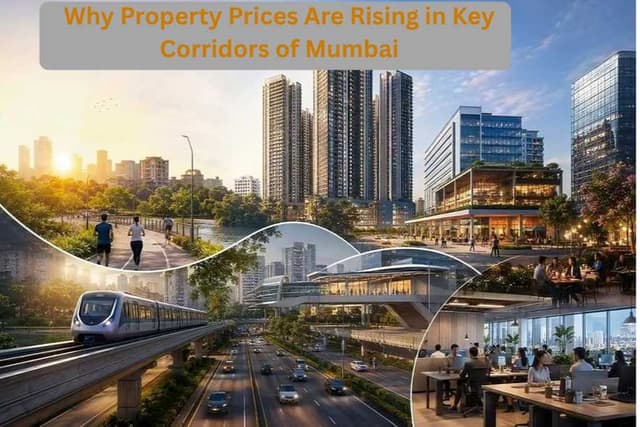
Mumbai’s real estate market has always been closely linked to connectivity. A neighbourhood may have good homes, schools and shopping options, but if reaching the workplace takes hours every day, buyers often think twice before moving there. That equation is now changing rapidly.
Over the past few years, Mumbai and the wider Mumbai Metropolitan Region (MMR) have seen a major expansion of metro lines, roads, bridges, tunnels and business districts. At the same time, technology companies, financial firms and global businesses are expanding their office presence in areas outside traditional commercial centres.
- Verified Tenants/Buyers
- Unlimited Property Listing
- Zero subscription/charges fee
Together, these developments are changing where people want to live, where developers launch projects and how property values are determined.
A recent analysis by The Economic Times noted that infrastructure improvements such as the Mumbai Trans Harbour Link, Navi Mumbai International Airport, Coastal Road, metro expansion and Goregaon-Mulund Link Road are widening the residential catchment around employment hubs. It also reported that areas such as Chembur, Mulund, Bhandup, Thane, Kandivli, Malad and Borivali recorded property price increases of around 10–12% over the previous two years, according to industry experts.
Metro Connectivity Is Redrawing Mumbai’s Residential Map
Metro rail is becoming one of the most visible factors influencing Mumbai real estate. For homebuyers, its biggest benefit is simple: it can make daily travel more predictable.
Mumbai already has several operational metro corridors, while more lines are being added or extended. According to the Mumbai Metropolitan Region Development Authority, a section of Metro Line 2B became operational in April 2026, with another section opening in August 2026.
The effect of metro connectivity is not limited to people living immediately next to a station. Better connections can make neighbouring areas more attractive because residents can access employment centres without depending entirely on private vehicles or buses.
Research published by the National Bureau of Economic Research on Mumbai’s first metro line found that residential and commercial property values in areas affected by the line increased by an estimated 6–8% compared with nearby control areas after the line opened. The study identified shorter travel times and improved access to employment as possible reasons behind the increase.
This helps explain why areas along existing and upcoming metro corridors are receiving greater attention from developers and buyers.
For example, the eastern and western suburbs are increasingly being connected through new transport routes. Locations around Powai, Vikhroli, Kanjurmarg, Jogeshwari, Mulund and Bhandup are benefiting from the combination of transport and employment connectivity.
The important change is that buyers are no longer looking only at the distance from South Mumbai or a railway station. They are increasingly asking how many transport options a neighbourhood will have over the next few years.
Roads Are Making Peripheral Areas More Accessible
Metro rail is only one part of the infrastructure story. Mumbai’s roads, bridges and tunnels are also changing the way people view locations outside the traditional city core.
The Mumbai Trans Harbour Link, Coastal Road and other major road projects are reducing travel barriers between different parts of the MMR. These links are particularly important for areas such as Navi Mumbai, Thane and the eastern suburbs.
The Atal Setu, for instance, has strengthened the road connection between Mumbai and Navi Mumbai. Combined with airport development and other transport projects, this is supporting the wider expansion of the Navi Mumbai property market.
Data cited by The Economic Times shows the growing importance of Navi Mumbai and Thane in the residential market. In the first quarter of 2026, Navi Mumbai accounted for 34.5% of residential sales in the cited market data, while Thane accounted for 14.4%.
This does not mean that every property near a road project will automatically become more expensive. Local factors such as construction quality, traffic, water supply, social infrastructure and the distance from the actual access point still matter.
However, better roads can make a previously inconvenient location practical for a larger group of buyers.
Tech Parks Are Bringing Homes Closer to Jobs
The second major change is happening in the commercial property market.
Mumbai is no longer dependent on a small number of traditional business districts. Office activity is spreading towards suburban and peripheral areas, creating new employment centres.
Powai, Andheri East, Goregaon, Malad, Thane and the Thane-Belapur Road belt are examples of locations where residential and commercial development increasingly overlap.
The latest Mumbai market data from Cushman & Wakefield shows that Mumbai recorded 4.1 million sq ft of office leasing in the second quarter of 2026. Thane-Belapur Road was the most active office corridor during the quarter, while Powai saw new Grade A office supply. H1 2026 office leasing reached 10.7 million sq ft, according to the firm.
For residential real estate, this matters because employees generally prefer homes that provide reasonable access to their workplaces.
When a large technology park or business campus comes up in an area, the effect can extend beyond office buildings. It can increase demand for nearby apartments, rental homes, restaurants, shops, schools, gyms and other everyday services.
This creates a cycle where employment encourages housing demand, and housing demand encourages more local development.
Powai and the Eastern Suburbs Show the Changing Pattern
Powai is a good example of how employment and infrastructure can work together.
The area already has established residential communities and office developments. New transport links can strengthen its relationship with nearby employment zones such as Vikhroli, Andheri East and SEEPZ.
Recent commercial real estate activity also shows continued interest in Powai. In September 2026, Brookfield India REIT announced the acquisition of office condominium units in the Delphi commercial tower in Powai for ₹75.2 crore.
This kind of commercial activity can have a wider effect on the residential market. Employees working nearby may look for housing within a shorter commute, while landlords can see stronger rental demand from professionals.
The proposed and developing metro network around the eastern suburbs adds another layer to this story.
Navi Mumbai Is Becoming More Closely Linked to Mumbai
Navi Mumbai is another major example of infrastructure-led real estate development.
For years, Navi Mumbai offered relatively planned neighbourhoods and large residential areas, but its relationship with Mumbai was limited by travel time. New road infrastructure, metro expansion and the Navi Mumbai International Airport are changing that equation.
The result is a broader real estate market in which buyers can consider locations beyond Mumbai’s municipal boundaries while still remaining connected to major employment and commercial centres.
The airport is particularly important because airports can create demand for offices, hotels, retail, logistics, housing and supporting services.
This does not mean all of Navi Mumbai will develop at the same pace. Different nodes will experience different levels of demand depending on transport links, employment creation and the availability of supporting infrastructure.
Tech Parks Are Also Changing Rental Demand
The impact of technology parks is particularly visible in the rental market.
Young professionals and employees relocating for work often prefer homes that reduce their daily travel time. They may choose a smaller apartment close to an office rather than a larger home that requires a long commute.
As office clusters grow, landlords in nearby neighbourhoods can benefit from a larger pool of potential tenants.
Mumbai’s office market is expected to remain an important source of this demand. CBRE estimates that Mumbai could see annual office-space demand growth of 12–15% over the next four years, from an average of 11.8 million sq ft between 2022 and 2026. The company also points to Global Capability Centres (GCCs) as an important driver.
GCCs are offices established by multinational companies to handle functions such as technology, finance, research and business operations. Their expansion means that demand for good-quality office space is increasingly coming from companies looking for long-term workplaces.
That can support residential demand in nearby areas.
Thane-Belapur Road Is Emerging as a Major Employment Corridor
The Thane-Belapur Road belt demonstrates how commercial and residential real estate can grow together.
It has become an important office corridor, with technology, engineering, financial and other businesses occupying commercial developments across the region.
The latest Mumbai office market data identifies Thane-Belapur Road as the most active office corridor in Mumbai during Q2 2026.
For homebuyers, this creates more options. Instead of concentrating only on central Mumbai or established western suburbs, employees can consider housing in Thane, Navi Mumbai and surrounding locations.
This geographical spread can also encourage developers to launch larger residential projects where land availability is better than in the crowded central parts of Mumbai.
Better Infrastructure Is Changing What Buyers Consider a Good Location
Traditionally, Mumbai buyers often focused on railway stations, main roads and established neighbourhoods.
Those factors remain important, but the definition of a convenient location is becoming broader.
Today, buyers may consider:
Distance from a metro station
Access to major roads and highways
Travel time to office districts
Availability of schools and hospitals
Access to shopping and entertainment
Future infrastructure projects
Quality of surrounding roads
Rental demand
Availability of public transport
This is particularly relevant for younger homebuyers who may change workplaces during their careers.
A home that connects easily to several employment hubs can be more practical than one that is close to only a single office district.
Infrastructure Is Also Influencing New Housing Projects
Developers are responding to these changes by looking beyond traditional locations.
Areas that were previously considered too far from established Mumbai neighbourhoods can become attractive when a new metro station, highway connection or business district improves accessibility.
Colliers reported that Mumbai added around 3.6 million sq ft of Grade A office space in the first half of 2026, with notable additions in Navi Mumbai, Powai and Thane.
This combination of office expansion and transport investment can influence the location of future housing projects.
Developers may increasingly look for land close to employment corridors rather than simply focusing on established residential addresses.
The Impact Is Different for Every Neighbourhood
Infrastructure does not affect every property in the same way.
A home located a few minutes from a metro station may benefit from improved accessibility, while another project several kilometres away may see a smaller impact.
Similarly, a new road can improve connectivity but may also bring traffic and noise to properties located immediately alongside it.
The stage of development also matters. Some neighbourhoods may see price increases before a project is completed because buyers anticipate better connectivity. In other locations, the effect may become visible only after the infrastructure begins operating and actual travel times improve.
For buyers and property investors, this makes it important to examine the complete local picture rather than relying only on the name of an infrastructure project.
Mumbai’s Real Estate Growth Is Becoming More Regional
Perhaps the biggest change is that Mumbai’s property market can no longer be viewed only within the boundaries of the main city.
Mumbai, Thane, Navi Mumbai, Panvel, Kalyan-Dombivli and other parts of the MMR are becoming increasingly interconnected through roads, metro lines, railways and employment hubs.
The MMRDA’s 2026–27 plans include several major connectivity projects, including the Thane-Borivali underground road tunnel and other transport infrastructure intended to improve regional movement.
At the same time, strong office demand is creating new employment centres outside the traditional commercial core. Mumbai’s office market recorded healthy leasing in H1 2026, while technology, BFSI and engineering companies remained important occupiers.
For Mumbai real estate, this means the next phase of growth is increasingly being shaped by connectivity plus employment. Metro stations make commuting easier, roads expand the practical boundaries of the city, and tech parks create reasons for people to live closer to emerging business hubs.